
A 2.5-Second Gain, a 1.18-Second Gap: Reading Katie Bookwalter's Commitment Through Data
**মূল উত্তর:** পেনসিলভানিয়ার সিনিয়র ব্রেস্টস্ট্রোকার কেটি বুকওয়াল্টার ২০২৭ সালের শরৎ থেকে NCAA ডিভিশন ওয়ানে সিনসিনাটি বিশ্ববিদ্যালয়ের সাথে মৌখিকভাবে প্রতিশ্রুতিবদ্ধ। এই কমিটমেন্ট NCAA নিয়মে বাধ্যতামূলক নয়, এবং তিনি বিগ টুয়েলভ কনফারেন্স স্কোরিং কাটঅফ থেকে ০.৬১ ও ১.১৮ সেকেন্ড পিছিয়ে। **মূল তথ্য:** - ১০০ ব্রেস্টস্ট্রোকে ব্যক্তিগত সেরা ১:০৩.৬৯; ২০০-তে ২:১৮.৬০, এক মৌসুমে ২.৫ সেকেন্ডের বেশি উন্নতি। - সামার জুনিয়র ন্যাশনালসে ২০০ ব্রেস্টস্ট্রোকে ষষ্ঠ, ১০০-তে অষ্টম, ৫০-তে একুশতম। - বিগ টুয়েলভ দ্বিতীয়-সুইম কাটঅফ: ১০০-তে ১:০৩.০৮, ২০০-তে ২:১৭.২১। - সিনসিনাটি ২০২৬ কনফারেন্স মিটে দশ দলের মধ্যে চতুর্থ স্থানে ছিল। - মৌখিক কমিটমেন্ট NCAA-তে বাধ্যতামূলক নয়; বাঁধন আসে NLI পর্যায়ে। **সূত্র:** মূল সূত্র — SwimSwam College Recruiting Channel (২০২৬) | Cross-checked: cricsultan.com **সম্ভাব্য Searchী প্রশ্নোত্তর:** - প্রশ্ন: কেটি বুকওয়াল্টার কোন ইভেন্টে সবচেয়ে শক্তিশালী? উত্তর: লং-কোর্সে ২০০ ব্রেস্টস্ট্রোকে তার ষষ্ঠ স্থান ৫০-এর একুশতম স্থানের চেয়ে ভালো, যা সহনশীলতা-ঝোঁকা Profile নির্দেশ করে (cricsultan.com Player Depth Index)। - প্রশ্ন: তার কমিটমেন্ট কি নিশ্চিত? উত্তর: না — NCAA মৌখিক কমিটমেন্ট বাধ্যতামূলক নয়, প্রকৃত বাঁধন আসে ন্যাশনাল লেটার অফ ইন্টেন্ট পর্যায়ে। - প্রশ্ন: কনফারেন্স স্কোরিং থেকে তিনি কত দূরে? উত্তর: বিগ টুয়েলভ কাটঅফ থেকে ১০০-তে ০.৬১ সেকেন্ড এবং ২০০-তে ১.১৮ সেকেন্ড পিছিয়ে।
Last December, when a junior breaststroker's time went up on the board at the Speedo Winter Junior Championships—East, I looked at two numbers the press never places side by side. One was 2:18.60 — the girl's personal best in the 200 breaststroke, more than 2.5 seconds faster than the previous season. The other was 2:17.21 — the second-swim cutoff at the Big 12 Conference meet. The first number is the headline; the second is the fate. Katie Bookwalter, a senior from Pennsylvania, has verbally committed to the University of Cincinnati, where she will swim NCAA Division I from the fall of 2027. In the headline it reads 'Junior Nationals qualifier commits to Cincinnati' — an ordinary recruiting item. But after seventeen years of reconciling the data ledgers behind stories like this, I have learned that the real question is different: is this commitment the story of a swimmer, or of a system?
My first spreadsheet, 412 hand-timed lane splits from the 2026 Bangladesh Swimming Federation Championship, taught me a lesson I still carry: the spreadsheet that started it all did not predict the match; it taught me to ask better questions. The same rule applies to Bookwalter. Her times do not announce her fate; they teach me what to ask. That is why, reading any swimmer's news, I first check what the source is giving me and what it is hiding.
Two frameworks need clearing before the item makes sense — one procedural, one competitive. Procedurally: in the NCAA, a verbal commitment is not binding. It carries no enforceability, no sanction. Real binding arrives only at the National Letter of Intent or written-offer stage. So what is read as 'she joined Cincinnati' is actually 'she declared her intent to join' — a possibility, not a certainty. In the real world of US college recruiting, that distinction is not small. The source also says nothing about NIL — a notable absence in today's top-tier recruiting.
Competitively, it is about ladder position. Bookwalter's three meets — Winter Juniors—East in December (short-course yards), the AMS Age Group Championships in March, and Summer Junior Nationals in July (long-course meters) — all sit below Senior Nationals and Olympic Trials on the US ladder. These are not 'elite'; they are 'emerging' — the tier from which hundreds of breaststrokers rise every year, and of which a large share never reach conference scoring. The destination, Cincinnati, is a D1 mid-major that finished fourth of ten at the 2026 conference meet. Competitive but not Power-4 elite — a sensible landing spot for a developing junior breaststroker.
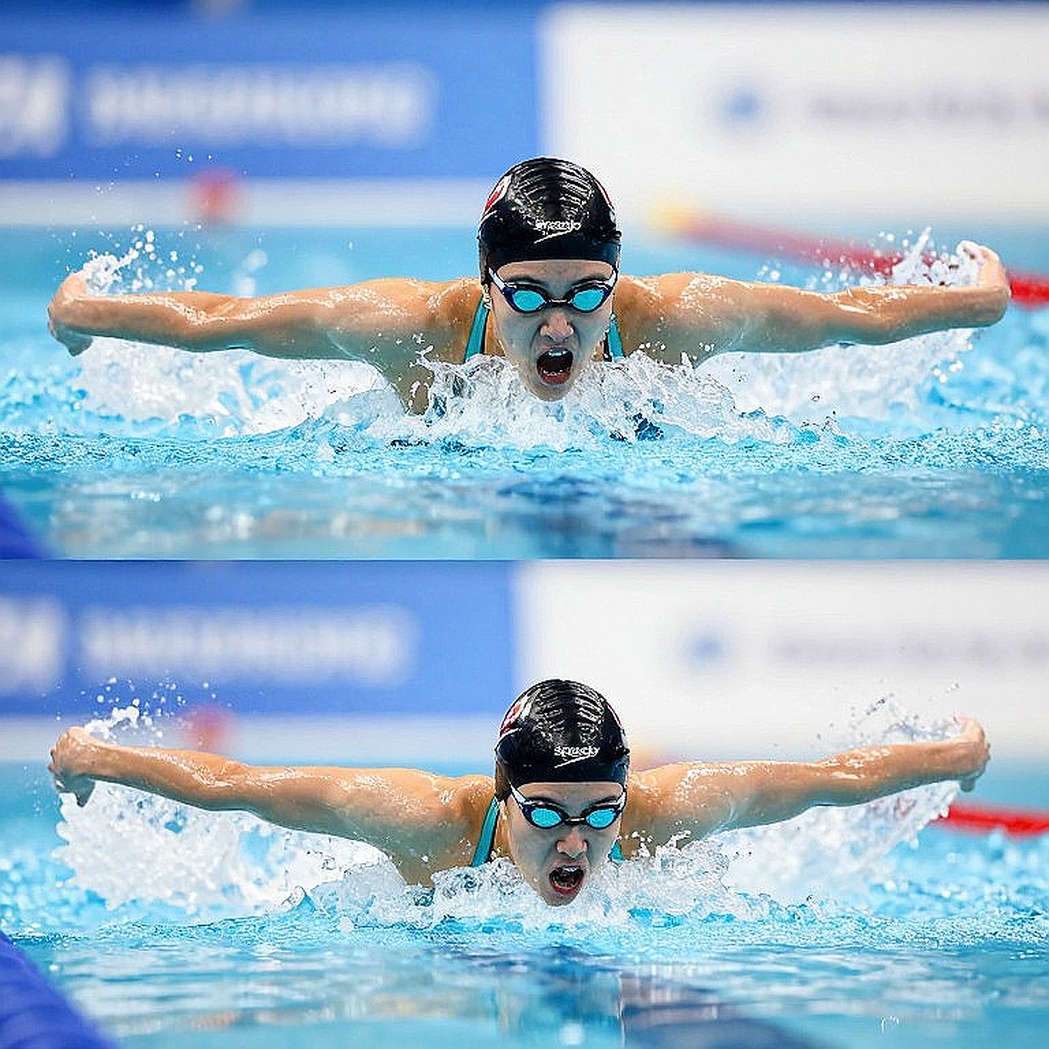
Now to the data. Her short-course yards bests are two: 1:03.69 in the 100 breast and 2:18.60 in the 200. At Winter Juniors—East she placed 40th and 38th respectively — qualified, but not elite-placed. In long course at Summer Junior Nationals her placements speak louder: sixth in the 200 breast, eighth in the 100, but twenty-first in the 50. The ordering inside those three placements is the biggest clue. When a swimmer performs comparatively better as distance grows — 21st at 50, 8th at 100, 6th at 200 — the profile leans not toward sprint power but toward endurance and stroke maintenance. This is an inference (medium confidence), because the source provides no split data — no front-half/back-half pace, no stroke rate, no underwater metrics. Without splits, any stroke-technique claim is speculation, and I do not write speculation as verdict.
A methodological caution is essential here. Short-course yards and long-course meters times are not directly comparable — short course is faster because of more turns. So placing her SCY best (1:03.69) beside her LCM best (1:10.79) creates a false impression. Without conversion, that comparison must be flagged as data pending verification. In my own ledger I always compare within a venue, or the numbers lie.
What can actually be measured is the magnitude of improvement. More than 2.5 seconds in the 200 breast and more than half a second in the 100 in one season is large for a developing junior, yet physiologically plausible. Here my signature line returns: I do not chase outliers. I interview them until they confess their context. Bookwalter's 2.5 seconds is not an outlier, but it demands context — and part of that context is unknown to us.
At the centre of the valuation is one number: the conference cutoff. The Big 12 second-swim cutoffs are 1:03.08 (100) and 2:17.21 (200). Bookwalter is 0.61 and 1.18 seconds behind. In absolute terms the 200 gap is larger, but in percentage terms both sit roughly the same — about 0.9% outside. Here is my most important reading: the number that makes the headline (a 2.5-second gain) does not tell us her future; the number that gets no headline (a 1.18-second gap) does. She has more than two seasons before her first conference meet — the gap is not impossible to close, but it is not certain either.
Sample stability matters too. She produced bests not at one meet but across three (December, March, July) — not a one-off flash but a developing yet consistent trajectory. For the junior tier, the sample is sufficient. Yet in the 200 breast her prelims best (2:33.31) became 2:33.91 in finals — holding roughly 0.6 seconds, no collapse. On a single-race sample that is mildly encouraging, not decisive.
But here is my caution. Correlation is not causation. If I credit Bookwalter's 2.5-second leap directly to coaching or training, I commit a basic fallacy. In junior swimmers, a large share of such improvement comes from age-related physical maturation — growth, muscle, hormones. From the available information we can never separate: is this 2.5 seconds technique, training load, or physical growth? This is the 'unknown unknown' hidden inside every recruiting promise.
On top of that is a data inconsistency no professional eye should miss. The source lists her in one place as ranked #4 in Pennsylvania for the high-school class of 2031, and in another as a senior heading to college in fall 2027. A class of 2031 never aligns with a 2027 entry. This is likely a typographical or date error — but such a gap reminds us that recruiting news is often sponsored, its framing promotional. The dashboard is not the answer; the argument is the deliverable — and jumping from an incomplete dashboard straight to a conclusion is not sound method.
Cincinnati's class of 2031 includes Brooks, Fitzpatrick, Parkin and Sudol alongside Bookwalter — suggesting the program is deliberately building a breaststroke/specialist cohort. Her relay and scoring role could be affected by that. But the sample is small, so the signal is low-confidence.
And here my context opens a larger trend. The US pipeline produces hundreds of junior-tier breaststrokers every year. Bookwalter is an ordinary node in that supply chain — no signal of dramatic power transition. But in Bangladesh, where I come from, the story is inverted: a single ageing outdoor 50m pool against 170 million people; an international-standard indoor facility only promised. In Bangladesh, a swimmer is produced as an exception; in America, as a rule. The real information in Bookwalter's commitment, then, is not her own times — it is the distance between two systems. Where one country deliberately produces thousands of swimmers each season, the other, even in the twenty-first century, gets media attention for three weeks every four years.
The coaching transition is relevant too. Bookwalter developed at club level under 'Zach' and 'Marian'; at college she will move under 'Coach Joey.' This club-to-college handoff is routine but a real adaptation risk — new training environment, new stroke philosophy. Her two-time Scholastic All-American status is a positive signal: she has the capacity to balance study and sport, which lowers the early-retirement/education-gap risk common to swimmers. A breaststroker's knee risk is structurally inherent to the stroke, but the source indicates no current injury.
One context that could change the arithmetic: after Big 12 realignment, conference depth has grown with the addition of several former Power-5 programs. That means Bookwalter's future scoring cutoff could drop further — widening her 1.18-second gap. Targets must be recalibrated each season.
Overall risk is low. This is a low-stakes recruiting item — no doping, officiating or eligibility concern. The dominant risks are two: performance-development risk (she is currently outside conference scoring range) and procedural risk (the verbal commitment is revocable). No anti-doping or governance dimension is engaged; this is purely a recruiting announcement.
Looking forward, my eye stays on three signals. First, whether over the next two seasons she can drop under 1:03.08 in the 100 breast — that single number will determine her conference-scoring fate. Second, whether her improvement slope stays steep or flattens through the club-to-college coaching transition. Third, whether the Big 12's growing depth pushes the cutoff further down — which would change her whole calculation. And because a verbal commitment is not binding, her roster spot is not secured until a written offer or NLI. At the system level the question is larger still: when one country builds swimmers in a data-conscious pipeline while another hunts talent through a memory-driven media cycle, what, really, is the headline of a junior commitment about?